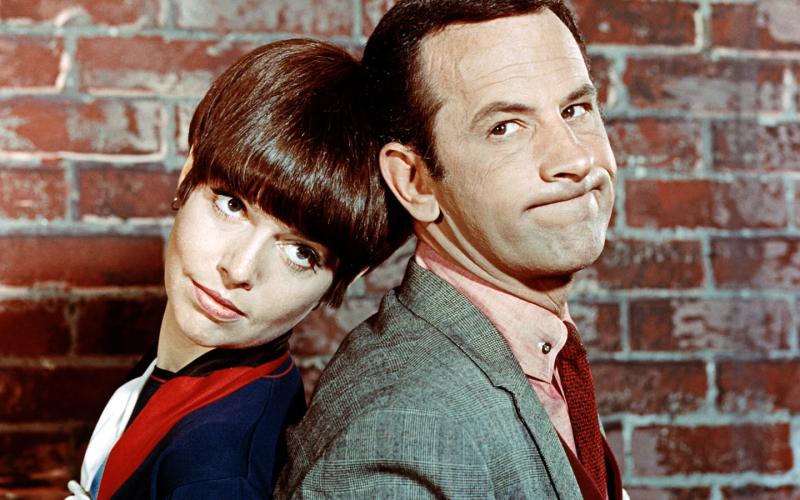

Would you believe that Mel Brooks and Buck Henry teamed up to create one of the funniest spy shows of the 1960s?
Capitalizing on the success of the James Bond franchise, television networks ordered a slew of espionage-themed programs. The Man From U.N.C.L.E, I Spy, Mission Impossible, and The Avengers brought a new level of sophistication to catching bad guys. These series used intelligence, ingenuity, and gadgetry to capture villains and save the world. Get Smart was created by Brooks and Henry to spoof the genre. The series drew inspiration from its serious counterparts and took scenarios and gadgets farther into the absurd.
The complexities of espionage were simplified for the half-hour comedy format of Get Smart. Agent 86 Maxwell Smart (Don Adams) works for CONTROL, a U.S. spy agency focused on shutting down the evil organization KAOS. With the help of Agent 99 (Barbara Feldon), the Chief (Edward Platt), and a host of other CONTROL agents, the bumbling Agent Smart defeats KAOS villains at every turn. Also assisting Max is the latest in 1960s spyware.

In the 1959 premiere episode of The Twilght Zone, Earl Holliman explores a town completely deserted. After helping himself to some ice cream from the drug store soda fountain, he encounters wire spinner racks full of paperbacks, one of which is filled entirely with copies of the ominously titled “The Last Man on Earth.”
In the age of the electronic book, wire book racks (as well as drug stores that serve ice cream) are things of the past. In the golden age of the paperback, though, they were how books made their way to the masses. Drug stores, supermarkets, newsstands, and even gas stations, each had spinning paperback racks somewhere; And, from there, the rugged cowboys, monstrous space aliens, and wicked femme fatales on the book covers all vied for your attention and your 35 cents.
Ultra Swank – Your one stop blog for retro living, style and design
Ultra Swank takes you back in time into the kitsch, chic and swank living of the 50s, 60s and the 70s. We mainly focus on the design, architecture and the lifestyle of the happy-go-lucky and space-age-living mentality of that era – but also on the music and movies that takes you back to happier times. Ultra Swank is run by Chris, a Swede born in the wrong decade that currently resides in Barcelona. Read more
Subscribe and follow Ultra Swank
Santa Claus Conquers the Martians (1964) begins with a hastily prepared animation sequence set to the sonic stylings of children singing “Hooray for Santa Claus.” Once the songs ends, we are told by the newscaster for KID-TV that they have sent a news crew to the North Pole to interview Santa Claus. I got excited upon hearing this news, only to find out in the end credits that the role of Santa was played by someone named John Call, which incidentally was my stage name for a brief while in college. Andy Henderson, on location from KID-TV provides a tour of Santa’s Workshop (though really just a set built for the film) and a quick run-through of some hard-working bearded elves led by Winky. Santa appears to enjoy his pipe more than the Standards and Practices people may have liked, but he enjoyed it in spite of them.

Here are a bunch of fine examples of postcards you probably won’t be sending to your friends and family.. or then again, maybe you might. If you want to see more fun-tastic, creepy, dodgy and simply plain weird examples, head over to Bad Postcards where you will have a whole collection of things gone horribly wrong.
Shot by Academy Award-winning cinematographer Vilmos Zsigmond as a modern re-imagining of early silent film, LOUIS is an homage to Louis Armstrong, Charlie Chaplin, beautiful women and the birth of American music. The grand Storyville bordellos, alleys and cemeteries of 1907 New Orleans provide a backdrop of lust, blood and magic for 6 year old Louis (Anthony Coleman) as he navigates the colorful intricacies of life in the city. Young Louis’s dreams of playing the trumpet are interrupted by a chance meeting with a beautiful and vulnerable girl named Grace (Lowry) and her baby, Jasmine. Haley, in a performance reminiscent of the great comic stars of the silent screen, plays the evil Judge Perry who is determined not to let Jasmine’s true heritage derail his candidacy for governor.
I love seeing modern music videos that carry a retro twist. The artists always seem to have so much fun and introducing new audiences to retro fashion and culture is never a bad thing.Those of us interested in dressing up in retro fashions might find it too expensive or too difficult to locate the items to do so, but we can always live vicariously through the magic of the music video.
My first entry is thanks to UK girl group The Saturdays. These lovely ladies covered Depeche Mode’s 80′s hit “Just Can’t Get Enough” making this a Retro-Retro tribute video. Watch the girls prance around in pinup-style clothing as the infectious song plays in the background–it’s sure to become your earworm for the day.
All of the great pinup styles are represented in this video; from the boudoir babe to the armed forces cutie, making sure the male readers of Ultra Swank will enjoy the fashion post as much as the female readers will…but for different reasons of course. One thing though; as an 80′s baby should I be concerned the 80′s are now considered retro as well? Hmm. Enjoy the video, Ultra Swank readers! If you want more of The Saturdays, here they are covering the 60′s hit “Please Mr. Postman.”

Loosely based on the series of Matt Helm novels by Donald Hamilton, “The Silencers” features Dean Martin as erstwhile counter agent Matt Helm. Not to be confused with the counter agent at Northwest who lost my luggage last week. Helm isn’t a secret agent who spies and stuff, he just causes problems for other spies. Which is good work if you can get it. Helm was formerly with the organization I.C.E. (Intelligence and Counter Espionage).
Released within months of the premiere of his popular long-running TV show, “The Dean Martin Comedy Hour” in 1966, “The Silencers” is the first of four films starring Dean Martin as Matt Helm. Highly successful when released, “The Silencers” was followed the same year by “Murderer’s Row,” in the next year by “The Ambushers,” and two years later in “The Wrecking Crew” from 1969.