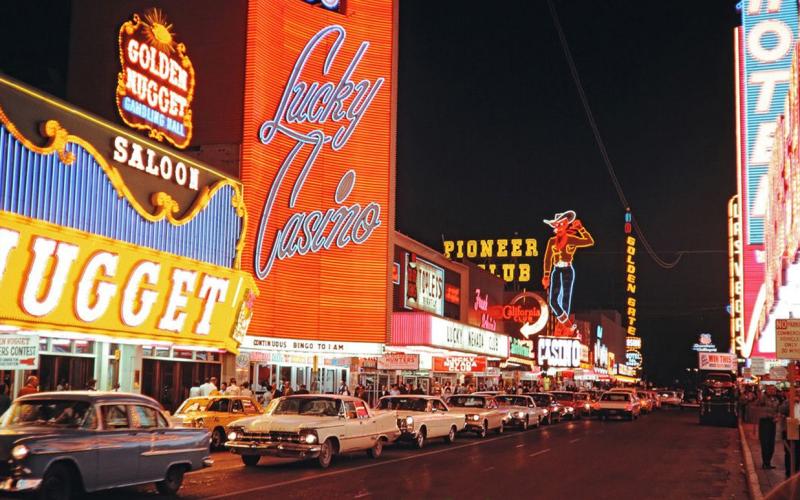
On September 7, 1963, during a performance at the Sands Hotel and Casino in Las Vegas, Dean Martin joked “Right now, ladies and gentlemen, somewhere backstage, Frank Sinatra is punching a dealer right in the mouth.” Little did Martin know that four years later, Sinatra actually would start a fight with a Sands pit boss over revoked casino credit — only, in the end, it was Sinatra who received the pop to the mouth.
The golden age of Las Vegas was the 1950s and early 60s — the Rat Pack era. Who made it that way? The Mob. What did they do? They ran gambling operations of every kind. And it was the worst kept secret in America. Everyone knew that it was mobster Bugsy Siegel who built one of Vegas’s crown jewel casinos, The Fabulous Flamingo. And it still stands today — although it’s been properly sanitized, corporatized, and remodeled.

Mid-century retro goes by many names — Retro culture; Atomic culture — and it sometimes overlaps with many other subcultures like kustom kulture (i.e. hot rod & rockabilly fans); tiki culture, and even Goth. My preferred term for this subculture is Lounge Revival.
To the outside observer, it would seem that the only thing your average Lounge Revivalist is interested in is dressing up in old clothes and drinking himself silly in a bar that has seen better days. And while Jeff “Beachbum” Berry’s popular cocktail books would reinforce that idea, in truth not every lush is a Lounge Revivalist. (And not every Lounge Revivalist is a lush.)
No, regardless of their chosen flourishes — rockabilly, tiki, noir, what lies in the heart of a true Lounge Revivalist is a romantic streak and a wistful love of things others have discarded. You can see it in the woman wearing a Jackie Kennedy pill box hat, in the man sporting a pair of leopard creepers, or even in the noirish goth-a-billy guy buying old Esquivel! records at the thrift store for $10 a stack. Australian DJ Koop Kooper would call all these people members of Cocktail Nation.
Ultra Swank – Your one stop blog for retro living, style and design
Ultra Swank takes you back in time into the kitsch, chic and swank living of the 50s, 60s and the 70s. We mainly focus on the design, architecture and the lifestyle of the happy-go-lucky and space-age-living mentality of that era – but also on the music and movies that takes you back to happier times. Ultra Swank is run by Chris, a Swede born in the wrong decade that currently resides in Barcelona. Read more
Subscribe and follow Ultra Swank

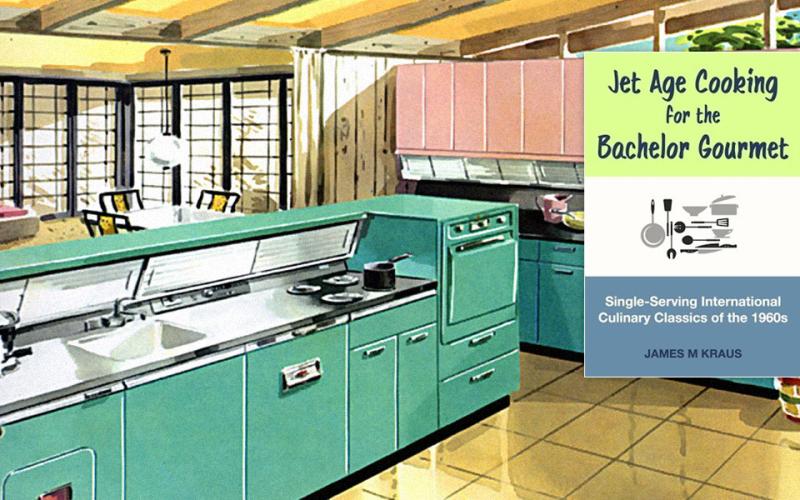
Thanks to a post-World War II economic and technological boom, the 1950s and early 60s was the golden age for the bachelor lifestyle. With the advent of Playboy magazine, the quintessential guide to urban living, it reached critical mass. Armed with affluence, abundant leisure time, and the sagacity of Saint Hefner, bachelors found themselves with two things: freedom and optimism.
The ultimate expression of this was the bachelor pad. More than just a place to dwell, the bachelor pad was a place to work, play, and truly live. It was a micro-world outfitted and dressed in whatever manner Playboy and one’s wallet decided.

In America, the 1950s and 60s spawned The Monster Kids. These were kids, mostly pre-adolescent boys, who assembled Aurora model kits of Frankenstein or Dracula after school; read Tales From The Crypt comics with a flashlight under the covers at bed time; and sneaked downstairs on Saturdays to watch the late-night horror movie show on TV with spooky hosts like Zacherle, Chilly Billy, or Ghoulardi. And they discussed it all in their super-secret tree houses on Sunday — no girls allowed.
Some of these youngsters went on to become highly influential adults in genre entertainment: horror novelist Stephen King; fantasy film directors John Landis, Joe Dante, and Steven Spielberg; and shock rock musician Gene Simmons of the band KISS are but a few of many Monster Kids who turned their obsessions into their careers.

The first of its kind, Airport set the standard for the disaster films of the 1970s. Films such as The Poseidon Adventure (1972), The Towering Inferno (1974), and my favorite – Rollercoaster (1977) collected A-list, B-list, and C-list movie stars and put them into some pretty crummy situations. But their pain is our pleasure; the films grossed a ton of money – Airport made over $100 million on a $10 million budget. Based on the novel by Arthur Hailey, Airport provides a cavalcade of Hollywood superstars – Burt Lancaster, Dean Martin, Jacqueline Bissett, George Kennedy, Helen Hayes, Van Heflin, Maureen Stapleton, and Barry Nelson.

“When a fresh-faced guy in a Chevy offered him a lift, Parker told him to go to hell.”
– Richard Stark, first line from The Hunter
On one side of a coin is James Bond, a suave secret agent with a license to kill. A connoisseur of many things, Bond enjoys fine food, fine women, and martinis shaken not stirred. A champion for Queen and country, readers have no difficulty cheering him on against Communists and megalomaniacs intent on world domination.
On the other more tarnished side of the same coin is Cary Grant’s John Robie, aka “The Cat” from the 1955 film To Catch A Thief. He’s a cool gentleman burglar who has used his skills and ill-gotten gains to finance his playboy lifestyle. Roguish but retired and reformed, the audience smiles when The Cat eludes police.
The person trying to steal that coin from both men is Parker, an independent career criminal. And while readers love his adventures, it can’t be said they’re admiring a hero.

In the 1959 premiere episode of The Twilght Zone, Earl Holliman explores a town completely deserted. After helping himself to some ice cream from the drug store soda fountain, he encounters wire spinner racks full of paperbacks, one of which is filled entirely with copies of the ominously titled “The Last Man on Earth.”
In the age of the electronic book, wire book racks (as well as drug stores that serve ice cream) are things of the past. In the golden age of the paperback, though, they were how books made their way to the masses. Drug stores, supermarkets, newsstands, and even gas stations, each had spinning paperback racks somewhere; And, from there, the rugged cowboys, monstrous space aliens, and wicked femme fatales on the book covers all vied for your attention and your 35 cents.